Ossam
The Deer KingOssam are fierce wild mountain dogs native to Van’s homeland, feared as predators of pyuika and repeatedly mistaken for, or associated with, wolves. Their role reaches beyond attack: their behavior shapes Van’s practical knowledge of animals, while their resemblance to wolves becomes consequential in the investigation of disease and in the contested breeding of hunting dogs.
Identity and Range
Van recognizes an unfamiliar animal in the salt mine by its movements, which remind him of an ossam, though the darkness prevents him from identifying it with certainty. He knows the dogs as fierce and vicious mountain animals from his homeland. That recognition matters because the creatures attacking the prisoners are not simply an abstract menace: they evoke a predator whose habits Van already understands, even when he cannot be sure what he is seeing.
Ossam also belong to the ecological and cultural life of Van’s northern home. They breed prolifically, and people there shun them, claiming that their light-gold coats bear the light of the next world. After black wolves were culled, ossam numbers rose sharply. Van’s people hunt them in winter because they attack pyuika, making the dogs both a feared presence and a continuing pressure on the herds their communities depend on.
Attacks and Encounters
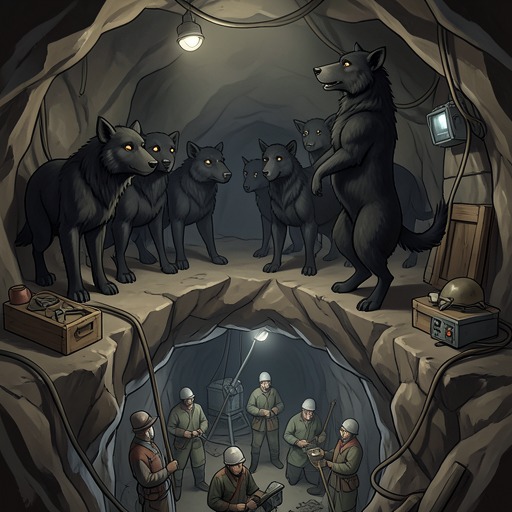
At the salt mine, a pack of black beasts rushes through the prisoners’ chamber, attacking the chained slaves as it passes. Van recognizes the possibility that the first animal is an ossam, and when one lunges at the man beside him, he kicks it away. The animal recovers with remarkable agility and then attacks another prisoner. It subsequently turns on Van; he manages to break its hold and drive it off, but the pack continues deeper into the chamber, biting those in its path. The chained prisoners cannot escape, and the attack leaves them frightened and wounded, though no one appears gravely injured.
In another encounter, a young traveler tells Van that a pack of ossam appeared near his camp after fallen trees forced him onto an unfamiliar route toward Kazan. The animals flowed around his cart and disappeared, but their sudden arrival frightened his pyuika, Tsupi. She tangled herself in her tether; when the traveler freed her, she knocked him down and ran into the forest. With his ankle badly twisted, he could not follow and waited three days for help. The episode shows how an ossam encounter can disrupt travel and livestock handling even without a reported attack on the traveler himself.
The story of Tsupi’s disappearance also makes clear that the dogs’ scent and presence shape the herders’ understanding of animal behavior. Van reasons that, outside the autumn mating season, Tsupi would likely have returned once the ossam scent faded. In fall, however, a bull elk’s scent may have put her in heat and drawn her into the woods. The risk posed by predators is thus interwoven with seasonal movement and breeding rather than treated as an isolated danger.
Disease and Identification
Ossam are among the animals capable of transmitting black wolf fever through bites. The disease can also spread through fleas or ticks that have bitten infected animals or people, so the risk depends on more than the visible presence of a sick creature. Cold weather can leave fleas mostly dormant, though they may survive through winter in warmth, including on a dog or beside a hearth.
When sheep are reported attacked by wolves or ossam, Hohsalle rejects indiscriminate hunting as an unreliable preventive measure. If the attacking animals had carried the disease, the shepherds who were bitten would have died, yet no such cases have been reported. He therefore distinguishes the possibility of infected animals from proof that every wolf or ossam is dangerous, and argues that carriers must be identified rather than hunted at random. Ossam matter to public health not only as possible vectors but as animals whose appearance alone cannot establish whether they carry the disease.
That identification problem recurs in the mountains, where Van examines a dead animal that resembles a wolf but has differences in its ears, jaw, and coat. He notices a light-gold streak and compares the underside of its paws with those of an ossam. The paw marks are nearly identical, although the claws are spread somewhat differently. The beast is darker and larger than a typical ossam, and Van suspects that it may be among the creatures whose increase has coincided with the disappearance of young boar and deer. Careful observation, rather than a quick visual label, becomes essential to understanding what is multiplying in the forest.
Breeding and Cultural Meaning
The Aquafaese term rochai is derogatory for an ossam bred with a wolf. Yet the animals called rochai are prized by the Aquafaese as intelligent hunting dogs. Van’s people sometimes breed dogs with wolves, but they will not use an animal with ossam blood for hunting. The contrast makes the category culturally charged: what one community values as a capable hunting animal, another refuses to trust.
The distinction also bears on disease and responsibility. At a discussion of the Ahfal Oma, Cheehana identifies their hunting dogs as rochai, crosses between black wolves and ossam, and says that the Ahfal Oma regard them as a gift from Kinma. Her knowledge comes, she says, from an old story, which leads into Kinma’s commandments concerning what to do with a dead horse. The exchange connects the dogs’ mixed ancestry to a religious tradition, while leaving a tension between their honored status among the Ahfal Oma and the suspicion attached to them elsewhere.
Ecological and Narrative Significance
Ossam are not merely stand-ins for wolves. Their abundance changes after wolves are culled; they prey on pyuika; and their scent can influence whether a frightened animal returns to its keeper. Such details place them within a network of seasonal movement, animal breeding, hunting, and livelihood. Van’s knowledge of their behavior is local and practical, acquired in a setting where protecting herds means recognizing what hunts them.
At the same time, the story repeatedly makes certainty difficult. In darkness, a dog only seems like an ossam; in the forest, a wolf-like body reveals traces that may indicate ossam ancestry; in discussions of fever, even a confirmed species does not prove that an individual animal is infectious. Ossam thus sharpen the distinction between resemblance and identification, and between a community’s inherited judgment and evidence gathered from tracks, paws, behavior, and reported bites. Their significance lies in that double presence: they are immediate threats to people and livestock, but also a test of how carefully humans read the animals with whom they share their world.